
Waking up to no hot water is one of those household moments that ruins your whole morning. Whether it's a completely cold shower, water that's lukewarm at best, a cylinder that runs out too quickly, or strange rumbling noises coming from your hot water cupboard — hot water cylinder problems are common in Auckland homes and they range from simple fixes to full replacement jobs.
As a certified plumber who works with hot water systems every week across Auckland, Kurt at KA Plumbing has diagnosed and fixed every type of hot water issue. This guide walks you through the most common problems, what you can safely check yourself, and when it's time to call a professional.
Common Hot Water Cylinder Problems
1. No Hot Water at All
The most obvious and most urgent problem. If you have no hot water at all, the most common causes are a burnt-out heating element (in electric cylinders), a tripped circuit breaker at your switchboard, a faulty thermostat that's not calling for heat, or a pilot light that's gone out (in gas systems). For electric cylinders — which are the most common type in Auckland homes — a failed element is the number one cause of complete hot water loss.
Quick check: look at your electrical switchboard. If the hot water circuit breaker has tripped, reset it. If it trips again immediately, you likely have a faulty element — call Kurt on 021 277 9151.
2. Lukewarm Water or Inconsistent Temperature
If your water is warm but not properly hot, or the temperature fluctuates unpredictably, the most likely causes are a failing thermostat (not maintaining the set temperature), sediment buildup in the bottom of the cylinder (insulating the water from the element), a partially failed element (still heating but at reduced capacity), or a faulty tempering valve that's mixing too much cold water into the hot supply. In cylinders with two elements (top and bottom), one element may have failed while the other continues working — giving you some hot water but not enough.
3. Running Out of Hot Water Too Quickly
If your hot water used to last all morning but now runs out halfway through the second shower, several things could be happening. Your household's hot water demand may have increased (a new family member, more showers, a new dishwasher). A lower element may have failed in a dual-element cylinder, halving your effective heating capacity. Sediment buildup in the bottom of the tank reduces the volume of water available to be heated. Or the thermostat may have drifted to a lower setting over time.
It's also worth considering whether your cylinder is simply too small for your current household. The general guideline for New Zealand homes is 30-50 litres per person per day. A four-person household typically needs at least a 180-litre cylinder.
4. Leaking Cylinder
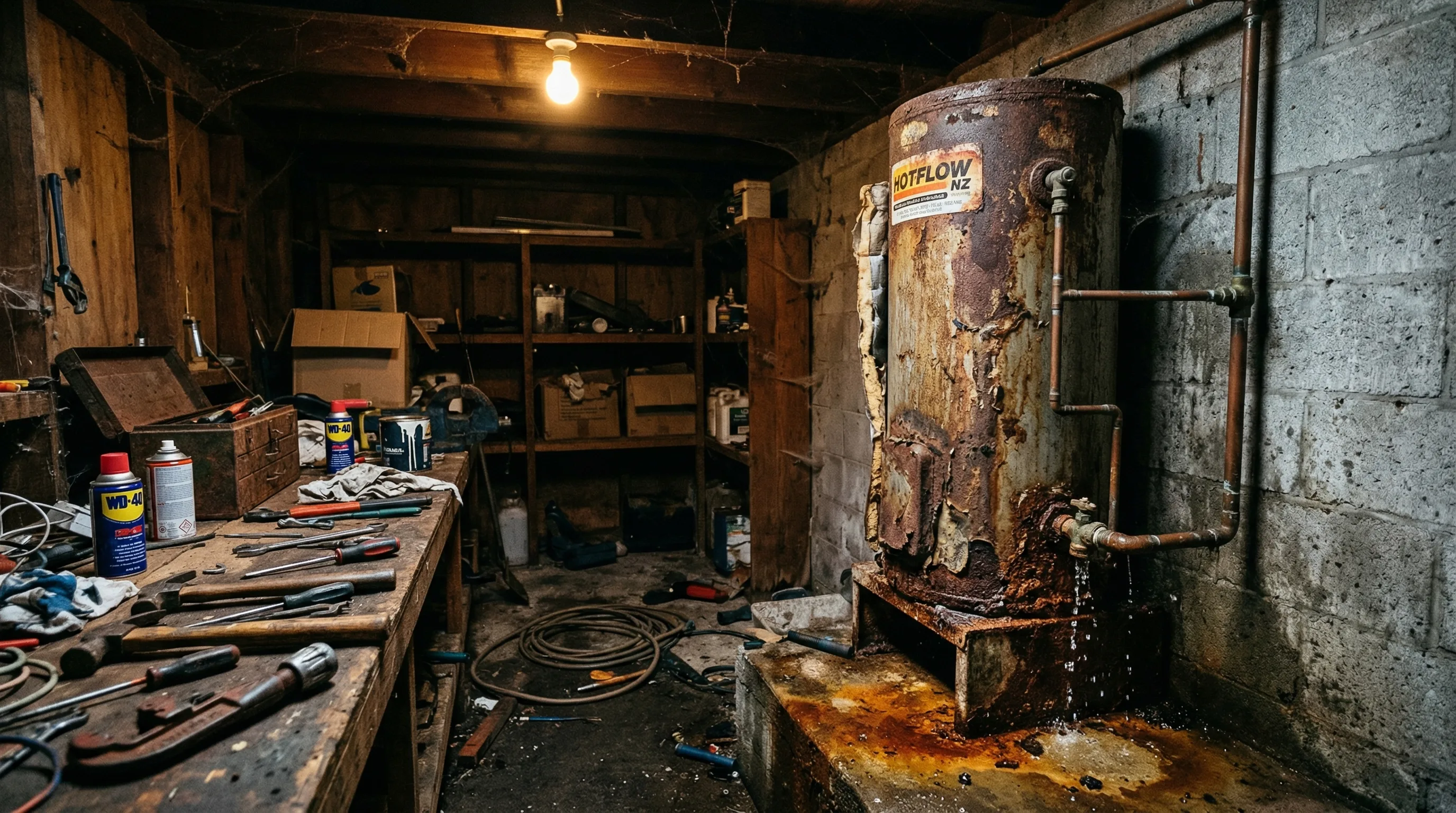
Water pooling around the base of your hot water cylinder is a serious issue that needs prompt attention. The most common sources of leaks are the temperature and pressure relief (TPR) valve — designed to release water when pressure or temperature gets too high — which may be operating correctly (indicating a pressure issue) or may itself be faulty. Other leak sources include corroded cylinder walls (indicating end of life), leaking pipe connections at the top or bottom of the cylinder, and a failed element seal.
A leaking TPR valve is a safety device doing its job. Don't cap it off or remove it — this is dangerous. Call Kurt to diagnose why it's releasing and fix the underlying cause.
5. Strange Noises
Rumbling, popping, cracking, or hissing sounds from your hot water cylinder are usually caused by sediment buildup at the bottom of the tank. As the element heats water through the sediment layer, it creates steam bubbles that pop and rumble — similar to a kettle. While not immediately dangerous, it indicates significant sediment accumulation that reduces efficiency, shortens element life, and decreases the usable hot water volume. A cylinder flush can resolve this in many cases.
6. Discoloured or Smelly Hot Water
Rusty or brown-tinted hot water usually indicates corrosion inside the cylinder — either a failing sacrificial anode (the protective rod inside the cylinder) or the cylinder walls themselves rusting through. A rotten egg smell typically indicates bacteria growth in the cylinder, which can occur when the thermostat is set too low (below 60°C) or in cylinders that have been unused for an extended period. Both issues warrant professional inspection.
Types of Hot Water Systems in New Zealand Homes
Understanding your system type helps diagnose problems and make informed decisions about repair vs replacement. Auckland homes typically have one of these systems:
- Electric low-pressure cylinder — the most common type in older Auckland homes. Uses a header tank in the roof space for pressure. Delivers lower water pressure on the hot side than the cold mains. Typical lifespan: 15-25 years.
- Electric mains-pressure cylinder — connected directly to the mains water supply, delivering equal hot and cold pressure. More efficient and comfortable than low-pressure systems. Found in newer homes and as upgrades in older properties. Lifespan: 15-20 years.
- Gas continuous flow — heats water on demand as it passes through a heat exchanger. No storage tank, so you never run out of hot water. Brands like Rinnai are common in Auckland. Lifespan: 15-20 years.
- Heat pump hot water — uses a refrigeration cycle (like a reverse air conditioner) to heat water. Very energy-efficient but higher upfront cost. Increasingly popular in Auckland as energy prices rise. Lifespan: 15-20 years.
- Solar hot water — uses roof-mounted solar panels to heat water, with an electric boost element for cloudy days. Less common in Auckland due to the climate but present on some properties.
When to Repair vs Replace Your Hot Water Cylinder
Not every hot water problem means you need a new cylinder. Kurt's general guidance for Auckland homeowners:
- Repair — if the cylinder is less than 10-12 years old and the issue is a failed element, thermostat, or TPR valve. These are straightforward, cost-effective repairs.
- Consider replacing — if the cylinder is 15+ years old, if repairs are becoming frequent, if the cylinder is leaking from the tank itself (not a fitting), or if you're experiencing ongoing issues despite repairs.
- Definitely replace — if the cylinder walls are corroded, if there's structural rust damage, if the cylinder is 20+ years old, or if you want to upgrade from low-pressure to mains-pressure for better hot water performance.
Kurt works with all major electric hot water brands in New Zealand including Rinnai, Dux, and Aquamax. He can advise on the best replacement system for your household size, budget, and energy goals — whether that's a mains-pressure electric cylinder or an energy-efficient heat pump system.
If a repair won't cut it, KA Plumbing handles hot water cylinder replacement across Auckland from diagnosis through to installation, with a free quote before any work starts.
What You Can Check Before Calling a Plumber
- Check your switchboard — is the hot water circuit breaker tripped? Reset it. If it trips again, you have a fault.
- Check the thermostat — some cylinders have an accessible thermostat dial. Ensure it's set to 60-65°C (the recommended range in NZ).
- Check for leaks — look around the base of the cylinder and at all pipe connections for signs of water.
- Check if it's just one tap — if only one tap has no hot water, the issue may be a localised valve or mixer cartridge, not the cylinder itself.
- Check your hot water timer — some Auckland homes have the hot water on a timer or ripple relay (off-peak electricity). Ensure it hasn't been switched off or the timer settings haven't changed.
No hot water? Kurt carries common cylinder parts on the van and can often restore your hot water the same day. Call 021 277 9151 to discuss the problem and availability.
Need Help With This Issue?
Call Kurt for fast, reliable service and free assessments across Auckland.
Related service: Hot water →